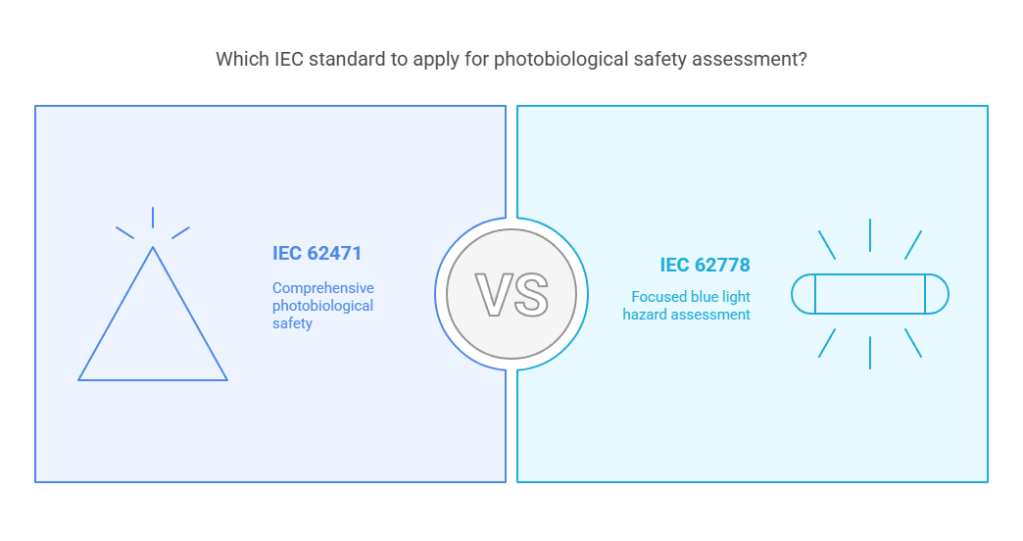
The main differences between IEC 62778 and IEC 62471 are as follows:
- Scope of application:
- IEC 62471 is a photobiological safety standard that applies to all luminaires and lamp systems, covering the assessment of radiation hazards of ultraviolet, visible and infrared rays, with a primary focus on the photobiological hazard classification of light sources (e.g. Class I, Class II, etc.).
- IEC 62778 focuses on blue light hazard assessment. It only measures and evaluates radiation hazards in the blue light band (380-800nm). This standard is suitable for light sources such as LEDs.
- Test content:
- IEC 62471 is based on the CIE S009:2002 text, which classifies photobiological hazards into 8 categories, including ultraviolet, blue and infrared hazards.
- IEC 62778 focuses on assessing the potential hazards of blue light to the retina. It redefines the three safety levels (RG0, RG1, RG2). It also emphasizes transmitting blue light hazard information from light sources.
- Test Method:
- IEC 62471 applies to a wider spectral range (200-3000nm), including ultraviolet, visible and infrared, and is measured for radiant intensity, brightness and irradiance.
- IEC 62778 focuses on the blue light wavelength band (380-800nm). It emphasizes the intensity and spectral distribution of blue light radiation.
- Updates & Replacements:
- IEC 62471 has completely replaced the EN 60825-1 standard as the alternative standard for the energy class requirements for LED products.
- IEC 62778 is a technical report for blue light hazard assessment. It mainly supplements the content of blue light hazard. However, it does not completely replace IEC 62471.
IEC 62471 is a comprehensive photobiological safety standard. IEC 62778 focuses on blue light hazard assessment. There are significant differences in the scope and focus of the test.
 INFINILUX
Leave a comment